

Why Can’t I Lift My Arm Above My Head? Causes & Treatment
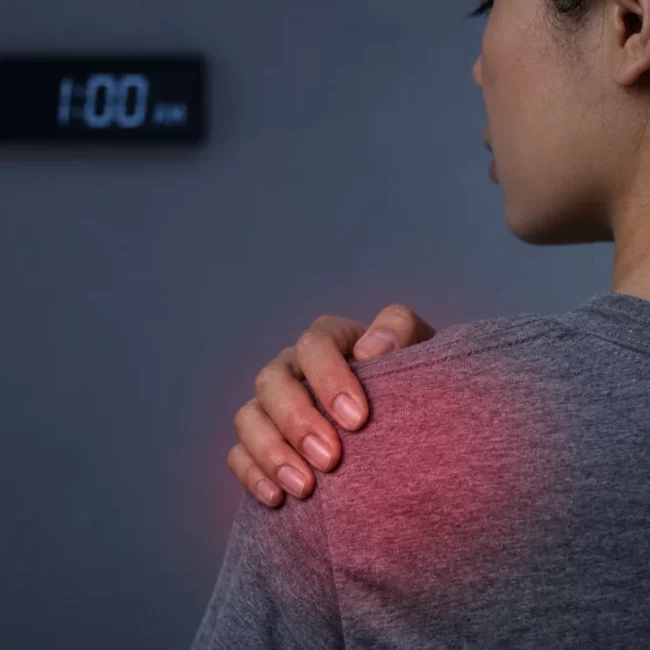
If you cannot lift your arm above your head, the cause may be pain, true muscle weakness, joint stiffness or an injury that has disrupted how the shoulder moves.
Common causes include rotator cuff problems, frozen shoulder, shoulder arthritis, bursitis or subacromial pain, traumatic tendon tears and, occasionally, a nerve problem coming from the neck.
The important distinction is this: Are you unable to lift the arm because it hurts, because it feels genuinely weak, or because the shoulder physically will not move any further?
Those three situations can look similar to a patient but may point toward very different diagnoses.
For example, the American Academy of Orthopaedic Surgeons’ guidance on rotator cuff injuries explains that the rotator cuff muscles and tendons help lift and rotate the shoulder. A tear can therefore affect a patient’s ability to raise the arm, particularly when weakness is present.
On the other hand, someone with frozen shoulder may have adequate muscle strength but find that the joint itself has become too stiff to move overhead.
That difference is one of the first things a shoulder specialist tries to establish.
Why Can’t I Lift My Arm Above My Head?
Raising your arm above your head looks simple, but it requires several structures to work together.
The shoulder joint must move freely, the rotator cuff must stabilise the top of the arm bone, the larger shoulder muscles must generate enough force, and the shoulder blade must rotate appropriately.
A problem affecting any part of this system can make overhead movement painful or difficult.
Broadly, difficulty lifting the arm tends to fall into four patterns:
| What you notice | What it may suggest |
| You can lift the arm, but it hurts | Rotator cuff-related pain, bursitis, tendinopathy |
| You try to lift it, but it feels genuinely weak | Rotator cuff tear or nerve-related weakness |
| The shoulder feels physically blocked or very stiff | Frozen shoulder or arthritis |
| You suddenly cannot lift it after an injury | Tendon tear, fracture, dislocation or another acute injury |
These are clues rather than diagnoses. Several conditions can produce more than one of these patterns.
1. Rotator Cuff Tendinopathy and Subacromial Shoulder Pain
One of the most common reasons for pain when lifting the arm is irritation involving the rotator cuff tendons and surrounding structures.
The rotator cuff is made up of four muscles and their tendons. Together they help stabilise the shoulder and allow controlled lifting and rotation.
Patients often describe pain when:
- reaching into a high cupboard
- putting on a shirt
- lifting weights overhead
- washing or drying their hair
- reaching away from the body
- lowering the arm after lifting it
Some patients can still raise the arm fully but have a painful section of movement, often called a painful arc.
The NHS guidance on shoulder impingement describes pain that becomes worse when lifting the arm, particularly overhead, and notes that weakness may sometimes accompany it.
 Does this mean something is being “pinched”?
Not necessarily. The term “shoulder impingement” is still commonly used, but shoulder pain is often more complex than one tendon simply being mechanically trapped.
Tendon load, tissue sensitivity, bursitis, shoulder strength and movement control may all contribute.
How is it treated?
Many patients improve without surgery.
Treatment may include modifying painful overhead activities temporarily, physiotherapy, progressive shoulder strengthening and appropriate pain relief.
A corticosteroid injection may sometimes be considered when pain is preventing rehabilitation, but injections are not required for every patient.
Surgery is generally not the first step for uncomplicated rotator cuff-related shoulder pain.
2. Rotator Cuff Tear
A rotator cuff tendon can be partially or completely torn. Some tears develop gradually over time, while others happen suddenly after:
- a fall
- lifting something unexpectedly heavy
- a shoulder dislocation
- a sporting injury
- another traumatic event
A rotator cuff tear becomes particularly important when difficulty raising the arm is caused by true weakness rather than pain alone.
You may notice that you can begin lifting the arm but cannot maintain it, or that the arm drops despite trying to hold it up.
Other symptoms can include:
- night pain
- weakness rotating the shoulder
- difficulty reaching overhead
- reduced ability to lift objects
- pain around the outer upper arm
- reduced function compared with the other shoulder
The AAOS rotator cuff injury guideline supports combining a clinical shoulder examination with ultrasound or MRI when a rotator cuff tear is suspected. It also makes clear that not every diagnosed tear requires immediate surgery.
Does a rotator cuff tear always require surgery?
No. Treatment depends on factors such as:
- whether the tear was traumatic
- tear size
- patient’s age
- activity requirements
- degree of weakness
- quality of the tendon
- functional limitation
- previous treatment
- general health
Physical therapy can improve symptoms in selected patients even when a full-thickness tear is present, although some tears may enlarge over time.
A younger or active patient who suddenly develops marked weakness after trauma may require a different treatment approach from someone with a longstanding degenerative tear and relatively preserved function.
3. Frozen shoulder
If your arm will not go overhead because the entire shoulder feels progressively stiff, frozen shoulder, or adhesive capsulitis, is an important possibility.
Frozen shoulder affects the capsule surrounding the shoulder joint. As the capsule becomes painful and tight, the available range of movement decreases.
Patients may have difficulty:
- reaching overhead
- putting their hand behind their head
- fastening clothing
- reaching behind their back
- putting on a jacket
- washing their hair
The defining feature is not simply pain.
With frozen shoulder, both active movement and passive movement become restricted. In other words, you cannot lift the arm normally yourself, and even if another person tries to move it for you, the shoulder remains restricted.
The NHS information on frozen shoulder describes pain and stiffness as the two main symptoms and notes that the condition may make shoulder movement very difficult.
How is frozen shoulder treated?
Most patients do not require surgery.
Treatment may involve:
- pain management
- gentle shoulder movement
- appropriately timed physiotherapy
- a corticosteroid injection in selected patients
Frozen shoulder can take many months to improve, and recovery time varies substantially.
The exercise programme also needs to suit the stage of the condition. Aggressively forcing a very painful shoulder is not always appropriate.
4. Shoulder osteoarthritis
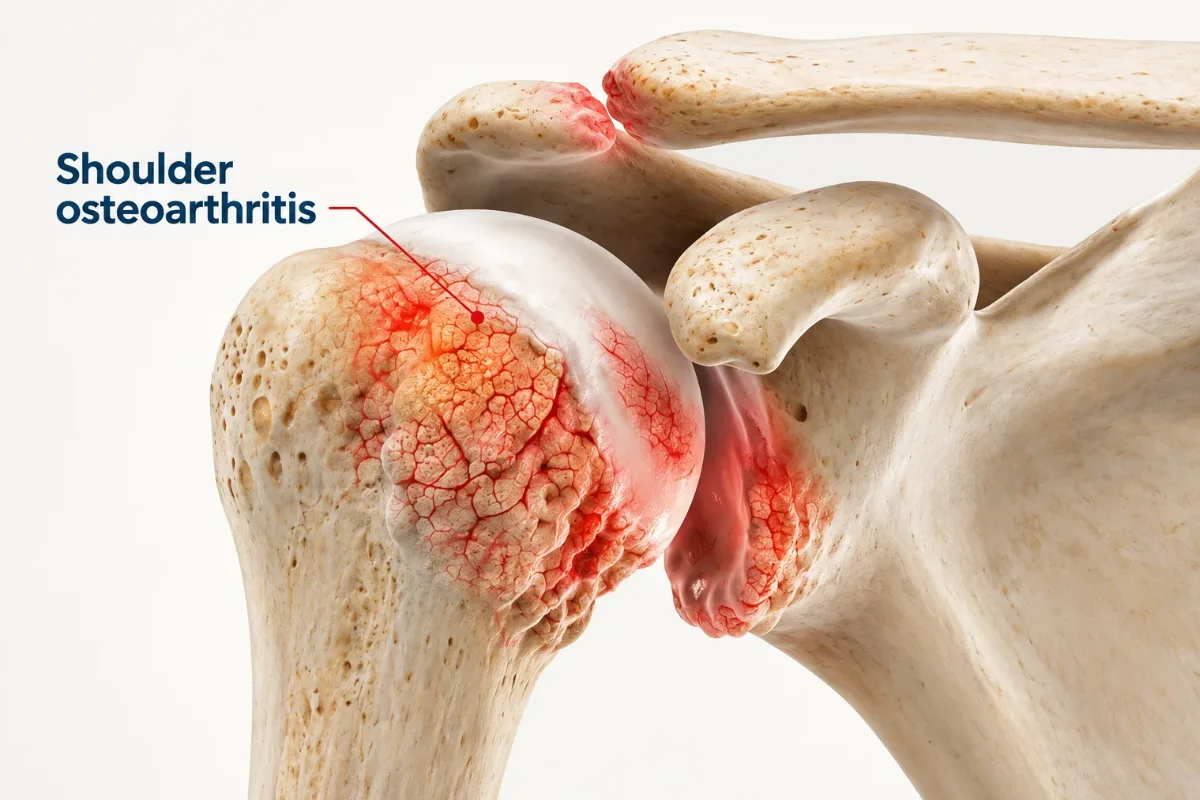
Arthritis can gradually make it difficult to raise the arm because the shoulder becomes both painful and mechanically stiff.
The main ball-and-socket joint of the shoulder is called the glenohumeral joint. In osteoarthritis, the smooth cartilage covering the joint surfaces becomes damaged. As the condition progresses, patients may notice:
- deep shoulder pain
- stiffness
- reduced overhead movement
- grinding or clicking
- pain during daily activities
- difficulty reaching behind the back
- pain at night
Does arthritis mean I need shoulder replacement?
Not automatically.
Earlier-stage treatment may include activity modification, physiotherapy or appropriate exercise, pain medication and selected injections.
AAOS guidance supports several non-surgical approaches before shoulder replacement is considered. Replacement may become appropriate when advanced arthritis is causing substantial pain and loss of function despite suitable conservative treatment.
5. Calcific Tendinitis
Calcific tendinitis occurs when calcium deposits form inside one of the rotator cuff tendons. Some deposits produce little or no discomfort. Others can trigger significant inflammation and make shoulder movement extremely painful.
A patient may suddenly feel that they cannot raise the arm because even small movements cause severe pain.
Symptoms can include:
- intense shoulder pain
- pain at rest
- painful overhead movement
- stiffness caused by pain
- night pain
An X-ray or ultrasound can often identify the calcium deposit.
Treatment varies according to the stage and severity of symptoms and may include pain management, physiotherapy and selected procedures such as shockwave treatment or ultrasound-guided lavage.
Surgery is reserved for selected persistent cases rather than being the automatic treatment.
6. Biceps or labral problems
Not all difficulty with overhead movement comes from the rotator cuff.
The long head of the biceps tendon passes through the shoulder and attaches near the upper part of the socket. The labrum is a rim of tissue around the socket that contributes to shoulder stability.
Problems involving these structures may make overhead movement painful, particularly in younger active patients or people involved in sports that require repetitive throwing or lifting.
Clues can include:
- pain at the front of the shoulder
- deep pain with overhead movement
- painful clicking
- catching
- a feeling of instability
- pain during throwing or pressing movements
However, clicking alone does not prove that a labral tear is present. Structural changes can also appear on an MRI without necessarily being the main source of a patient’s symptoms.
That is why the scan must fit the clinical examination.
7. Cervical Nerve Compression
Sometimes the shoulder itself moves normally when examined, but the patient still struggles to lift the arm because a nerve supplying the shoulder muscles is affected.
A nerve root in the neck can become compressed or irritated, producing cervical radiculopathy.
The Mayo Clinic’s information on cervical radiculopathy notes that cervical nerve compression can cause pain radiating from the neck into the shoulder or arm, together with numbness, tingling or weakness.
Clues that the problem may be coming from the neck include:
- neck pain
- pain extending below the shoulder
- tingling
- numbness
- burning or electric pain
- hand or arm weakness
- symptoms affected by neck position
This distinction matters.
A shoulder injection or shoulder operation is unlikely to solve weakness if the primary problem is compression of a cervical nerve.
For this reason, Dr. Marouane may examine the neck, sensation, reflexes and arm strength when the pattern of weakness does not fit a straightforward shoulder problem.
8. Injury: Dislocation, Fracture or Acute Tendon Rupture
If you suddenly cannot lift your arm after a fall, sporting injury or accident, the situation should be assessed differently from gradually developing shoulder pain.
Possible causes include:
- shoulder dislocation
- fracture
- acute rotator cuff tear
- significant ligament injury
- other traumatic damage
Do not repeatedly test or force a shoulder that appears deformed after trauma.
Pain, Weakness or Stiffness: Why The Difference Matters?
This is one of the most useful ways to think about the symptom.
“I can lift it, but it hurts”
This may point more toward rotator cuff-related pain, bursitis, tendinopathy or another painful soft-tissue condition.
“I am trying, but the arm feels weak”
True weakness raises greater concern for a substantial rotator cuff tear or neurological problem, particularly if the weakness developed suddenly.
“It simply will not move any further”
Marked restriction of both active and passive movement may suggest frozen shoulder or arthritis.
“I suddenly could not raise it after an accident”
This requires assessment for acute structural injury.
For Dr. Marouane, identifying which of these patterns is present is often more useful than immediately ordering an MRI.
What Does it mean if someone else can lift my arm but I cannot?
This is clinically important.
If another person can move your arm much further than you can move it yourself, the joint may still have a reasonable passive range of motion.
That can suggest that weakness or pain is limiting active movement rather than the joint being mechanically stiff.
A significant rotator cuff tear is one possible explanation.
By contrast, if neither you nor the examiner can move the shoulder much further, conditions such as frozen shoulder or advanced arthritis may become more likely.
This distinction is not perfect on its own, but it helps guide the rest of the examination.
How Is Difficulty Lifting the Arm Diagnosed?
A shoulder diagnosis should usually begin with the history and physical examination, not the scan.
The assessment may include:
- where the pain is located
- whether symptoms began suddenly or gradually
- whether there was an injury
- active range of motion
- passive range of motion
- rotator cuff strength
- shoulder stability
- biceps function
- neck movement
- sensation and reflexes
- comparison with the opposite arm
Imaging is then chosen according to the likely diagnosis.
1. X-rays
X-rays are useful for identifying:
- arthritis
- fractures
- dislocations
- bone changes
- calcific deposits
2. Ultrasound
Ultrasound can assess:
- rotator cuff tendons
- biceps tendon
- bursa
- certain dynamic abnormalities
3. MRI
MRI provides detailed information about:
- rotator cuff tears
- muscles
- labrum
- cartilage
- other soft tissues
However, the presence of an abnormality on MRI does not automatically mean it explains the patient’s symptoms.
AAOS guidance specifically supports using MRI or ultrasound alongside the clinical examination when investigating rotator cuff tears.
The useful question is therefore not only:
“What does the MRI show?”
It is:
“Does the MRI finding explain why this particular patient cannot lift the arm?”
Can I treat difficulty lifting my arm without surgery?
Often, yes. The appropriate treatment depends entirely on the diagnosis.
For many non-traumatic shoulder conditions, initial treatment may include:
- temporary modification of aggravating activities
- appropriate physiotherapy
- gradual strengthening
- mobility exercises
- pain medication when medically suitable
- selected injections
The NHS guidance on general shoulder pain recommends remaining gently active rather than completely stopping shoulder movement, while avoiding activities that clearly worsen symptoms.
That does not mean every patient should start the same exercises.
The treatment programme for frozen shoulder is different from rehabilitation after a rotator cuff tear, instability episode or fracture.

When might an injection help?
Injections can sometimes be useful for reducing pain enough to allow rehabilitation, but their role depends on the underlying condition.
A corticosteroid injection may be considered in selected patients with conditions such as:
- significant rotator cuff-related pain
- bursitis
- painful frozen shoulder
- shoulder arthritis
An injection should not substitute for identifying the cause of significant weakness.
For example, repeatedly injecting a shoulder with a substantial traumatic tendon tear without recognising the tear would not address the mechanical problem.
When is surgery considered?
Surgery is not based simply on whether the patient can lift the arm overhead.
It may be considered when there is a clearly defined structural condition and the likely benefit outweighs the risks.
Examples can include:
- selected acute traumatic rotator cuff tears
- persistent symptomatic tears with significant weakness
- recurrent shoulder instability
- certain labral injuries
- advanced arthritis
- selected persistent calcific tendon problems
- symptoms that remain significantly limiting despite appropriate non-surgical treatment
For rotator cuff tears specifically, the AAOS states that treatment decisions depend on factors including the patient’s age, activity level, cause and size of the tear, overall health and how symptoms affect daily life.
There is therefore no single treatment pathway for every patient who cannot raise the arm.
How long does recovery take?
There is no reliable single recovery time because the reason you cannot lift the arm may range from tendon irritation to frozen shoulder or major surgery.
Recovery depends on:
- the diagnosis
- severity of the condition
- whether surgery is needed
- size and quality of any tendon tear
- duration of symptoms
- rehabilitation progress
- age and general health
- occupational and sporting demands
A patient with mild rotator cuff-related pain may improve over weeks or months with rehabilitation, while frozen shoulder can remain restricted considerably longer.
Recovery following tendon repair also needs to respect biological tendon healing, so regaining movement does not necessarily mean the tendon is ready for unrestricted loading.
When should I see a doctor because I cannot lift my arm?
Arrange an assessment if:
- the problem is getting worse
- movement remains significantly restricted
- you have noticeable weakness
- symptoms persist despite appropriate initial care
- pain repeatedly disturbs sleep
- you cannot perform normal work or daily activities
- numbness or tingling accompanies the weakness
The NHS shoulder pain guidance recommends medical assessment when shoulder pain is worsening, has not begun improving after around two weeks, or when it becomes very difficult to move the arm.
A traumatic injury or significant weakness may justify earlier assessment rather than waiting.
When is inability to lift the arm urgent?
Seek urgent medical attention if:
- you suddenly cannot move the arm after an injury
- the shoulder has changed shape
- there is major swelling
- you heard a snap during a significant injury
- persistent pins and needles develop
- sensation is lost
- the arm feels unusually hot or cold
- there is severe pain with fever or feeling generally unwell
These are among the warning signs highlighted in current NHS shoulder pain guidance because they can accompany serious tendon injuries, fractures, dislocations or other conditions needing prompt assessment.
Frequently Asked Questions
1. Why can I lift my arm forward but not out to the side?
Different shoulder movements rely on different muscles and tendons. Rotator cuff pain or weakness may be more obvious during certain directions of movement. Examination can help identify whether pain, weakness or stiffness is responsible.
2. Can a rotator cuff tear stop me lifting my arm?
Yes. A substantial tear can cause weakness when raising or rotating the arm. However, not every rotator cuff tear causes major weakness, and some tears are found in people with relatively good function.
3. Can frozen shoulder stop me reaching overhead?
Yes. Frozen shoulder progressively restricts movement, including reaching overhead and behind the back. Both active and passive shoulder movement usually become limited.
4. Why can I raise my arm with my other hand but not by itself?
If the shoulder moves further when assisted, the joint may have reasonable passive movement but inadequate active movement because of pain or weakness. A rotator cuff problem is one possible explanation.
5. Does difficulty lifting the arm mean I need an MRI?
No. The history and examination usually help determine which imaging, if any, is needed. X-ray or ultrasound may sometimes be more appropriate initially.
6. Does a rotator cuff tear always need surgery?
No. Some patients improve with rehabilitation and non-surgical treatment. Surgery depends on the type of tear, weakness, function, activity demands and response to treatment.
7. Can shoulder arthritis stop me reaching overhead?
Yes. Arthritis can produce pain and progressive loss of shoulder movement. The AAOS describes decreased range of motion as a common feature of glenohumeral osteoarthritis.
8. Could weakness actually be coming from my neck?
Yes. Cervical radiculopathy can cause arm weakness along with pain, tingling or numbness.
9. Should I force my shoulder above my head to stop it becoming stiff?
Not without knowing what is causing the restriction. Gentle movement may be appropriate for many conditions, but forceful exercise can aggravate some injuries. The rehabilitation approach should match the diagnosis.
10. Can I continue gym exercises if I cannot raise my arm normally?
Heavy overhead loading is generally not sensible when movement is painful or clearly weak until the cause is understood. Activity can often continue in modified form, but the appropriate limits depend on the diagnosis.
11. How do I know whether the problem is pain or genuine weakness?
A clinical strength examination is the most reliable way to assess this. Patients sometimes describe an arm as “weak” because pain stops them using it, while true muscle weakness means the arm cannot generate normal force even when pain is accounted for.
Restoring overhead movement starts with identifying what is limiting it
Being unable to lift your arm above your head is not one diagnosis.
For one person, pain from an irritated rotator cuff may be preventing movement. For another, a tendon tear may have caused genuine weakness. Someone with frozen shoulder or arthritis may have lost joint movement itself, while another patient’s weakness may actually originate from a nerve in the neck.
For Dr. Marouane, Senior Orthopaedic Surgeon – Hand to Shoulder in Dubai, the first step is therefore to determine whether the restriction comes primarily from pain, weakness, stiffness or structural injury before deciding on imaging or treatment.
Many causes can be managed without surgery. Others, particularly sudden weakness after trauma or significant structural injury, may require earlier specialist evaluation.
If you are struggling to raise your arm, particularly if the problem is persistent, worsening or associated with weakness, a detailed assessment can help clarify what is preventing the movement and which treatment approach is appropriate for your shoulder.
Medical Disclaimer
This article provides general educational information and does not replace individual medical advice, diagnosis or treatment. Treatment suitability depends on the patient’s symptoms, examination findings, investigations, medical history and individual clinical circumstances.