

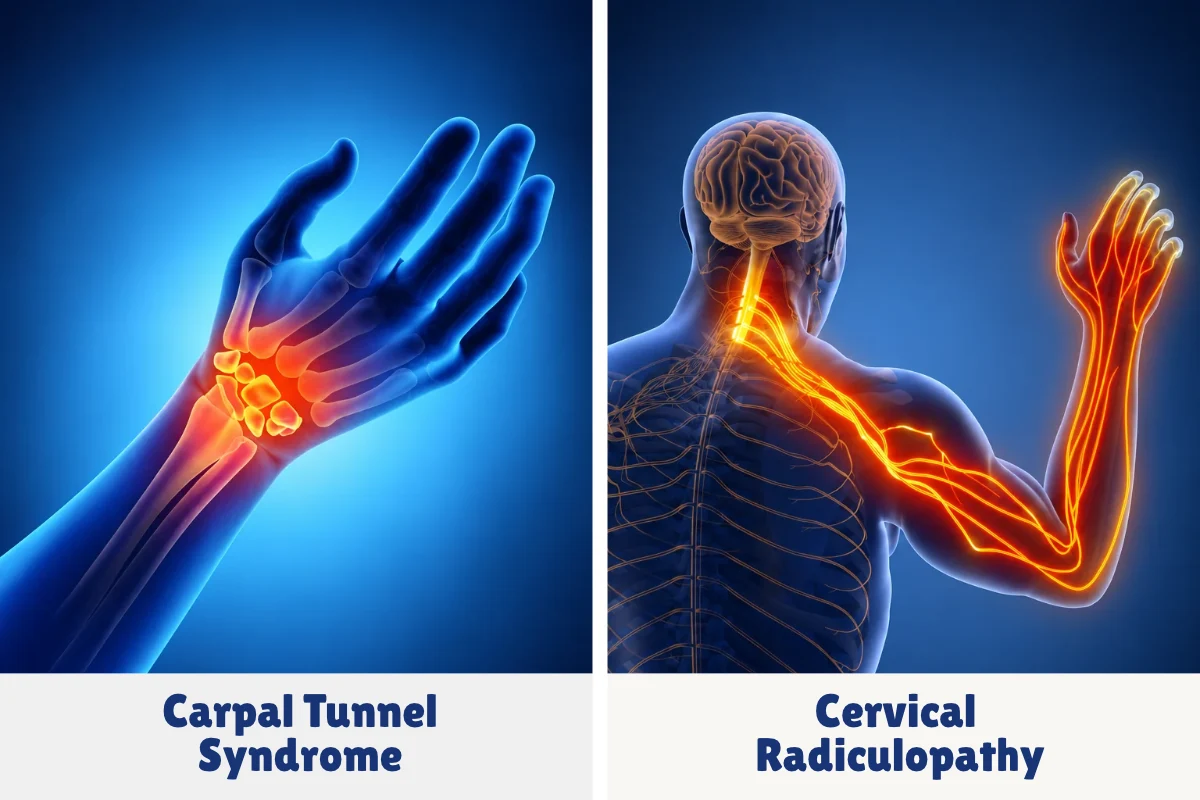
Key Differences: Carpal Tunnel Syndrome vs Cervical Radiculopathy
Carpal Tunnel vs Cervical Radiculopathy is an important distinction when evaluating hand numbness, tingling, or weakness. Although both conditions can cause similar symptoms, they affect different parts of the nervous system. Carpal tunnel syndrome occurs when the median nerve is compressed at the wrist, while cervical radiculopathy develops when a nerve root in the neck becomes irritated or compressed.
The key difference lies in where the nerve is affected. Both conditions can cause symptoms in the thumb, index, or middle finger, as well as hand weakness, clumsiness, and discomfort extending into the arm. However, nighttime numbness and tingling are more characteristic of carpal tunnel syndrome, whereas neck or shoulder pain radiating down the arm may suggest cervical radiculopathy.
According to guidance from the British Society for Surgery of the Hand, carpal tunnel syndrome typically affects the thumb, index, middle, and part of the ring finger, with symptoms often worsening at night. Cervical radiculopathy, in contrast, can cause pain, numbness, tingling, or weakness that travels from the neck through the shoulder and arm into the hand.
Recognizing these differences can help identify the possible source of your symptoms. However, symptoms can overlap, so a clinical examination and, when necessary, nerve conduction studies or other investigations may be needed to distinguish between the two conditions.
Carpal Tunnel Syndrome vs Cervical Radiculopathy
| Feature | Carpal Tunnel Syndrome | Cervical Radiculopathy |
| Problem location | Median nerve compressed at the wrist | Nerve root compressed or irritated in the neck |
| Common symptoms | Hand numbness, tingling, pain, and weak grip | Neck or arm pain, tingling, numbness, and weakness |
| Affected fingers | Thumb, index, middle, and part of the ring finger | Depends on the affected nerve root; may involve different fingers |
| Night symptoms | Often worse at night | May occur at any time |
| Neck pain | Not a typical direct symptom | May be present, but is not always necessary |
| Pain pattern | Usually affects the hand and wrist; may extend into the forearm | May travel from the neck or shoulder down the arm |
| Muscle weakness | May affect thumb strength and grip | May affect the hand, wrist, elbow, or other arm muscles |
| Reflex changes | Not typical of isolated carpal tunnel syndrome | May occur depending on the affected nerve root |
| Diagnostic tests | Clinical examination; nerve conduction studies when needed | Clinical neurological examination; EMG, nerve conduction studies, or neck MRI when indicated |
| Treatment | Wrist splint, activity modification, selected injections, or surgery when needed | Activity modification, medication, physiotherapy, or surgery in selected cases |
Important: These conditions can cause overlapping symptoms, and some people have both at the same time. A clinical examination helps determine the likely source of nerve compression.
What Is Carpal Tunnel Syndrome?
Carpal tunnel syndrome develops when the median nerve becomes compressed as it travels through the carpal tunnel at the wrist.
The median nerve provides sensation to the thumb, index finger, middle finger and part of the ring finger. It also supplies muscles involved in thumb movement.
According to the British Society for Surgery of the Hand’s patient guidance on carpal tunnel syndrome, typical symptoms include numbness or tingling in these fingers, hand or wrist pain, weak grip, clumsiness and symptoms that are particularly troublesome at night or early in the morning.
Patients often describe:
- waking at night with a numb hand
- shaking or rubbing the hand to relieve symptoms
- pins and needles while driving or holding a phone
- dropping objects unexpectedly
- difficulty with buttons or fine hand movements
- reduced grip strength
In more advanced cases, persistent median nerve compression can lead to weakness and wasting of the muscles at the base of the thumb.

What Is Cervical Radiculopathy?
Cervical radiculopathy occurs when a nerve root in the neck becomes irritated or compressed.
Possible causes include a cervical disc herniation, age-related narrowing around the nerve or other degenerative changes in the cervical spine.
The symptoms depend partly on which nerve root is involved.
The American Association of Neurological Surgeons’ information on cervical disc-related radiculopathy explains that nerve compression in the cervical spine can produce neck or shoulder-blade pain, pain travelling down the arm and numbness or tingling extending into the hand or fingers. Certain neck movements may also aggravate the symptoms.
Cervical radiculopathy may cause:
- neck pain
- shoulder or shoulder-blade pain
- pain travelling down one arm
- tingling or numbness
- weakness in the arm or hand
- symptoms affected by neck position
However, neck pain is not present in every patient. A person can occasionally present primarily with arm or hand symptoms.
Which Fingers Are Affected In Carpal Tunnel Syndrome?
Carpal tunnel syndrome most characteristically affects the thumb, index finger, middle finger and thumb-side portion of the ring finger.
The little finger is usually spared because it receives sensation mainly from the ulnar nerve rather than the median nerve.
That distribution is one of the most useful clues when evaluating possible carpal tunnel syndrome.
The BSSH guidance also notes that patients frequently report weak grip or clumsiness and that symptoms commonly become worse at night.
However, symptoms are not always perfectly textbook. Patients may describe the whole hand as numb, particularly when they are woken from sleep and find it difficult to identify exactly which fingers are affected.
This is one reason a detailed sensory examination can be helpful.
Which Fingers Are Affected By Cervical Radiculopathy?
The distribution depends on which cervical nerve root is involved.
A C6 nerve-root problem may produce symptoms extending toward the thumb and index-finger side of the hand. C7 radiculopathy can involve the middle finger, while C8 problems can extend toward the ring and little fingers.
This overlap explains why C6 cervical radiculopathy can sometimes look very similar to carpal tunnel syndrome.
A clinical review comparing cervical radiculopathy with peripheral nerve disorders notes that C6 radiculopathy can produce symptoms extending from the neck through the arm toward the thumb and index finger, whereas carpal tunnel syndrome more typically affects the median-nerve distribution in the hand.
Finger location alone therefore cannot always establish where the nerve is compressed.
Night Numbness: Does That Make Carpal Tunnel More Likely?
Yes, particularly when numbness repeatedly wakes you from sleep. Night symptoms are one of the more characteristic features of carpal tunnel syndrome.
Patients often wake with pins and needles or numbness and instinctively shake the hand to make the sensation settle.
The NHS information on carpal tunnel syndrome states that symptoms commonly become worse at night and may include numbness, tingling, hand pain and difficulty gripping.
Night symptoms do not prove that the problem is carpal tunnel syndrome, but they increase clinical suspicion when the finger distribution is also typical.
What Makes Cervical Radiculopathy More Likely?
A cervical source becomes more likely when symptoms begin around the neck or shoulder blade and travel down the arm.
Other clues include:
- neck stiffness or pain
- pain that changes with neck movement
- symptoms extending above the wrist
- weakness involving the elbow, wrist or shoulder as well as the hand
- changes in reflexes
- numbness that follows a broader arm pattern
The pattern of weakness can be especially useful.
For example, C6 radiculopathy can affect elbow flexion or wrist extension as well as sensation toward the thumb, whereas carpal tunnel syndrome mainly affects functions supplied by the median nerve beyond the wrist.
This is why examining only the fingers can miss part of the diagnosis.
 Can Carpal Tunnel Cause Pain All The Way Up The Arm?
It can. Carpal tunnel syndrome originates at the wrist, but discomfort can extend into the forearm and sometimes feel as though it travels farther up the arm.
Therefore, “my pain goes up my arm” does not automatically mean the neck is responsible. The distinction depends on the complete symptom pattern.
If numbness follows the classic median-nerve distribution, becomes worse at night and improves by shaking the hand, carpal tunnel syndrome becomes more likely.
If pain begins in the neck or shoulder and radiates down the arm, particularly when neck movements reproduce it, cervical radiculopathy becomes more likely.
Does Neck Pain Rule Out Carpal Tunnel Syndrome?
No. A patient can have neck pain for one reason and carpal tunnel syndrome for another. Similarly, the absence of neck pain does not completely rule out cervical radiculopathy.
This is why Dr. Marouane assesses the hand, wrist, elbow, shoulder and neck when symptoms do not fit neatly into one nerve-compression pattern.
The aim is to identify where the nerve is actually being affected, rather than choosing the diagnosis simply because the hand feels numb.
How Does The Physical Examination Distinguish Them?
A clinical examination looks for patterns rather than relying on one test. For suspected carpal tunnel syndrome, the examination may assess sensation in the median-nerve fingers, thumb strength, grip, muscle wasting and whether pressure or certain wrist positions reproduce the symptoms.
The BSSH notes that bending the wrist or gently tapping over the median nerve may be used during examination, although the diagnosis is based on the overall clinical picture.
For suspected cervical radiculopathy, examination may include neck movement, upper-limb strength, sensation and reflexes.
A cervical nerve-root problem may produce weakness in muscles that are not supplied by the median nerve at the wrist. Reflex changes can also support a cervical source.
No single examination manoeuvre is perfectly diagnostic, which is why several findings are usually considered togethe
Do I Need Nerve Conduction Tests?
Not every patient with typical carpal tunnel symptoms needs nerve testing. Nerve conduction studies may be used to assess how well the median nerve is working, but they are not always required when the history and examination make the diagnosis clear.
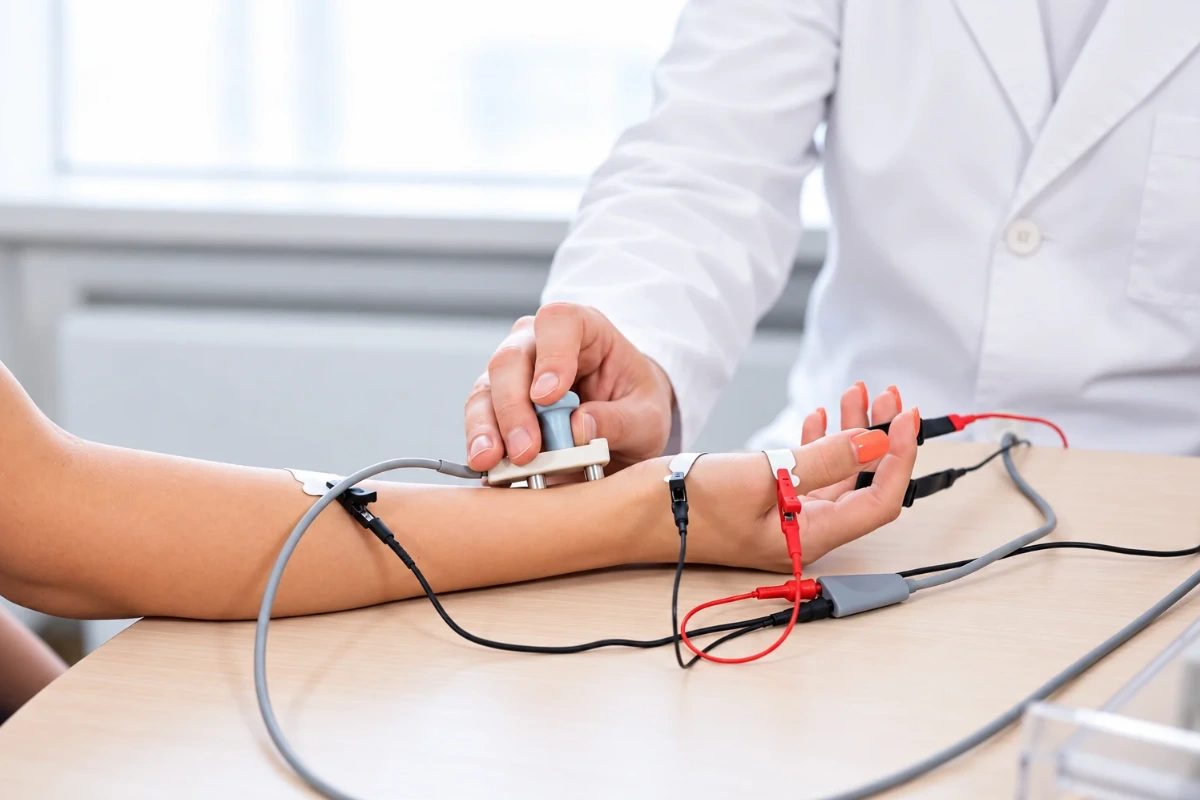
Testing becomes particularly useful when:
- symptoms are unusual
- the diagnosis is uncertain
- significant weakness is present
- cervical radiculopathy is also being considered
- more than one nerve may be involved
- surgery is being considered in a complex case
Nerve conduction studies measure how electrical signals travel through peripheral nerves. In carpal tunnel syndrome, conduction may become slowed as the median nerve crosses the wrist.
With cervical radiculopathy, the problem lies closer to the spine. Nerve conduction testing of the hand may therefore look relatively normal, while electromyography, or EMG, can sometimes identify changes in muscles supplied by the affected nerve root.
The results still need to be interpreted alongside symptoms and examination findings.
Do I Need An MRI Of My Neck?
Not automatically. MRI can provide detailed images of the cervical discs, nerve roots and spinal canal, but cervical MRI abnormalities become increasingly common with age and do not always cause symptoms.
The specialist guidance on diagnosing neck pain specifically notes that structural abnormalities may appear on X-rays or MRI even in people without corresponding neck symptoms, which is why imaging should be interpreted together with the history and physical examination.
An MRI may be considered when symptoms strongly suggest cervical radiculopathy, particularly when there is significant weakness, persistent symptoms, concern about spinal cord involvement or when treatment planning requires anatomical clarification.
An MRI of the neck does not diagnose carpal tunnel syndrome.
Can You Have Carpal Tunnel Syndrome And Cervical Radiculopathy At The Same Time?
Yes. A patient can have median nerve compression at the wrist and a cervical nerve-root problem at the same time.
This is sometimes discussed under the term double crush syndrome. However, the double-crush concept should be used carefully. While coexisting compression at two locations certainly occurs, research has not established that one site of compression always causes or worsens the other through a single proven mechanism.
For the patient, the practical point is simpler: finding one abnormality does not mean clinicians should stop looking if the symptoms do not fully fit.
A patient can have an abnormal neck MRI and genuine carpal tunnel syndrome—or confirmed carpal tunnel syndrome together with separate cervical symptoms.
How Is Carpal Tunnel Syndrome Treated?
Treatment depends on symptom severity and whether nerve function has started to deteriorate.
For mild or moderate symptoms, a neutral wrist splint worn at night is commonly used to prevent the wrist from remaining flexed while sleeping.
The BSSH also describes activity modification and corticosteroid injection as potential non-surgical treatments.
The current AAOS Clinical Practice Guideline on carpal tunnel syndrome reviews evidence across diagnostic and treatment options. Its plain-language guidance notes that several non-surgical interventions provide limited or short-term benefit, and corticosteroid injection should not be considered a reliable long-term solution for every patient.
When Is Carpal Tunnel Syndrome Considered?
Carpal tunnel release may be considered when symptoms are severe, persistent despite appropriate conservative treatment, or when there is concerning nerve dysfunction such as progressive weakness or muscle wasting.
The aim of surgery is to divide the ligament forming the roof of the carpal tunnel, creating more space for the median nerve.
Open and endoscopic approaches are both established techniques. The AAOS plain-language guidance reports that both can be safe and effective, with the choice depending on clinical circumstances and surgeon experience.
Long-standing severe nerve compression is important because sensation or strength may not fully return even after technically successful decompression.
How Is Cervical Radiculopathy Treated?
Many patients with cervical radiculopathy improve without surgery.
Treatment may include appropriate activity modification, medication, physiotherapy and progressive rehabilitation depending on the cause and severity of symptoms.
Mayo Clinic notes that many patients with acute cervical radiculopathy have a favourable natural history and do not ultimately require surgery.
The goal is not simply to eliminate every abnormality seen on an MRI. Treatment should address a nerve-root problem that matches the patient’s symptoms and neurological findings.
When Might Neck Surgery Be Considered?
Surgery may be considered when there is a clearly identified nerve compression that corresponds with the patient’s symptoms and one or more of the following are present:
- progressive neurological weakness
- significant persistent symptoms despite appropriate non-surgical treatment
- substantial functional loss
- another structural problem that requires decompression
The decision depends on the exact anatomical cause, the severity of neurological impairment and the patient’s overall circumstances.
Which Condition Is More Likely If I Keep Dropping Things?
Either can cause clumsiness, so dropping objects by itself does not identify the source.
With carpal tunnel syndrome, hand clumsiness may develop because the median nerve is affecting thumb function and sensation.
BSSH specifically lists weak grip and dropping objects among the symptoms that warrant medical assessment.
Cervical radiculopathy may also produce weakness, but it may involve additional muscles in the arm.
More widespread clumsiness, difficulty with buttons, changes in balance or symptoms affecting both hands can raise concern for a problem involving the cervical spinal cord rather than a single nerve root and should be assessed promptly.
When Are Hand Numbness Or Weakness More Urgent?
Most tingling does not represent an emergency, but progressive neurological symptoms should not simply be watched indefinitely.
Seek prompt medical assessment when numbness or weakness is rapidly worsening, you are losing strength in the arm or hand, or symptoms follow significant neck trauma.
Symptoms such as difficulty walking, loss of coordination, new bladder or bowel dysfunction or progressive weakness in multiple limbs can indicate spinal cord involvement rather than uncomplicated cervical radiculopathy.
Guidance on cervical spondylosis advises medical attention for sudden numbness or weakness and for neurological symptoms associated with cervical spinal disease.
With carpal tunnel syndrome, persistent numbness, increasing weakness or visible wasting at the base of the thumb also deserves assessment because prolonged severe nerve compression can lead to incomplete recovery.
Frequently Asked Questions
1. How can I tell if my hand numbness is coming from my wrist or my neck?
Carpal tunnel syndrome is more likely when numbness mainly affects the thumb, index, middle and part of the ring finger, becomes worse at night and improves when you shake your hand. Cervical radiculopathy becomes more likely when symptoms begin around the neck or shoulder and travel down the arm, particularly when neck movement changes them.
2. Why do my hands go numb mainly at night?
Nighttime numbness is characteristic of carpal tunnel syndrome, particularly when the median-nerve fingers are affected. Wrist position during sleep may contribute to increased pressure within the carpal tunnel.
3. Can neck problems cause hand weakness without severe neck pain?
Yes. Cervical radiculopathy does not always produce prominent neck pain. Some patients mainly notice arm pain, tingling or muscle weakness.
4. Can carpal tunnel cause neck or shoulder pain?
Carpal tunnel pain can extend into the forearm and patients may describe more widespread arm discomfort, but persistent neck or shoulder-blade pain should prompt consideration of another or additional source.
5. Is an EMG the same as a nerve conduction study?
They are related but different tests and are often performed together. Nerve conduction studies assess electrical signal transmission through peripheral nerves, while EMG evaluates electrical activity within muscles. Together they can sometimes help distinguish wrist-level median nerve compression from a cervical nerve-root problem.
6. Does a normal nerve conduction test rule out carpal tunnel syndrome?
Not in every situation. Clinical symptoms and examination still matter, particularly in mild or intermittent cases. BSSH notes that nerve tests are not always required when the clinical diagnosis is clear.
7. Do I need surgery if I have carpal tunnel syndrome?
Not necessarily. Mild or moderate symptoms may respond to measures such as a night splint or selected injections. Surgery becomes more relevant when symptoms are severe, persistent or accompanied by significant nerve dysfunction.
8. Does cervical radiculopathy always require neck surgery?
No. Many patients improve with non-surgical treatment. Surgery is generally considered when there is progressive neurological loss or persistent significant symptoms that correspond with a treatable structural problem.
Treatment Depends On The Location Of The Nerve Compression
Carpal tunnel syndrome and cervical radiculopathy can both cause numbness, tingling and weakness, but treating them as though they are the same problem can lead to the wrong intervention.
Carpal tunnel syndrome involves compression of the median nerve at the wrist. Cervical radiculopathy originates from a nerve root in the neck. The finger distribution, night symptoms, neck and arm pain, muscle weakness, reflexes and results of selected nerve tests can help distinguish the two.
For Dr. Marouane, Senior Orthopaedic Surgeon – Hand to Shoulder in Dubai, the priority is to determine where along the nerve pathway the problem is actually occurring before discussing an injection, carpal tunnel release or further cervical investigation.
If numbness, tingling or weakness is persistent, repeatedly waking you at night or causing you to drop objects, a detailed assessment can help clarify whether the problem is coming from the wrist, the neck or occasionally both.
Medical Disclaimer
This article provides general educational information and does not replace individual medical advice, diagnosis or treatment. Treatment suitability depends on the patient’s symptoms, neurological examination, investigations, medical history and individual clinical circumstances.