

What Is Stem Cell Signaling and Why Is It Important?
When people hear the term stem cell therapy, they often imagine stem cells physically replacing damaged tissue. While this can happen in certain situations, researchers now understand that one of the most important roles of stem cells is actually something much less visible they communicate.
Rather than acting alone, stem cells constantly send and receive biological messages that influence the cells around them. This process is called stem cell signaling, and it has become one of the most exciting areas of regenerative medicine. Instead of simply asking, “How many stem cells are present?”, scientists are now asking a different question: “What messages are those stem cells sending?”
Understanding these communication signals helps explain why regenerative treatments may support healing in certain conditions and why the body’s own repair system is far more sophisticated than previously thought.
What Is Stem Cell Signaling?
Stem cell signaling refers to the process by which stem cells communicate with other cells in the body through chemical signals.
Every cell in the body needs instructions. Cells must know:
- When to grow and multiply
- When to repair damaged tissue
- When to reduce inflammation
- When to stay inactive until needed
- When to develop into specialised cells, such as muscle, skin, or nerve cells
These instructions are delivered through cell signaling pathways.
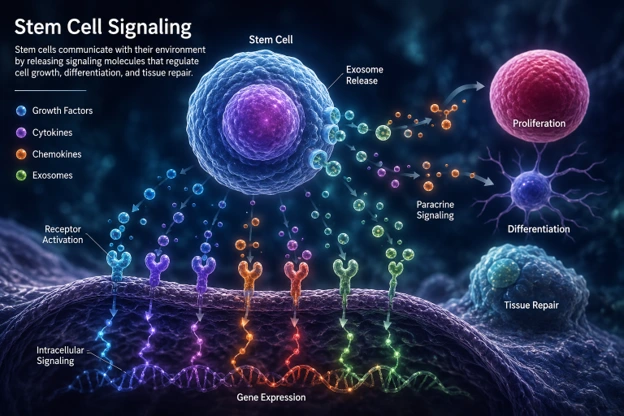
Instead of talking with words, cells communicate using proteins, growth factors, cytokines and other signalling molecules. These molecules travel to nearby cells or, in some situations, through the bloodstream to influence cells further away.
Think of stem cells as project managers rather than construction workers.
Instead of rebuilding tissue themselves, they often coordinate the repair process by directing other cells involved in healing.
Why Is Cell Communication So Important?
The human body contains trillions of cells.
For the body to function properly, every cell must work together.
Imagine a city where hospitals, police, engineers and emergency services never communicated with one another. Even if every department had skilled professionals, the city would quickly become disorganised.
The same principle applies inside the body.
Stem cell communication helps ensure that different cells respond together during healing rather than working independently.
Without proper communication, healing becomes slower, less organised and sometimes incomplete.
How Do Stem Cells Communicate?
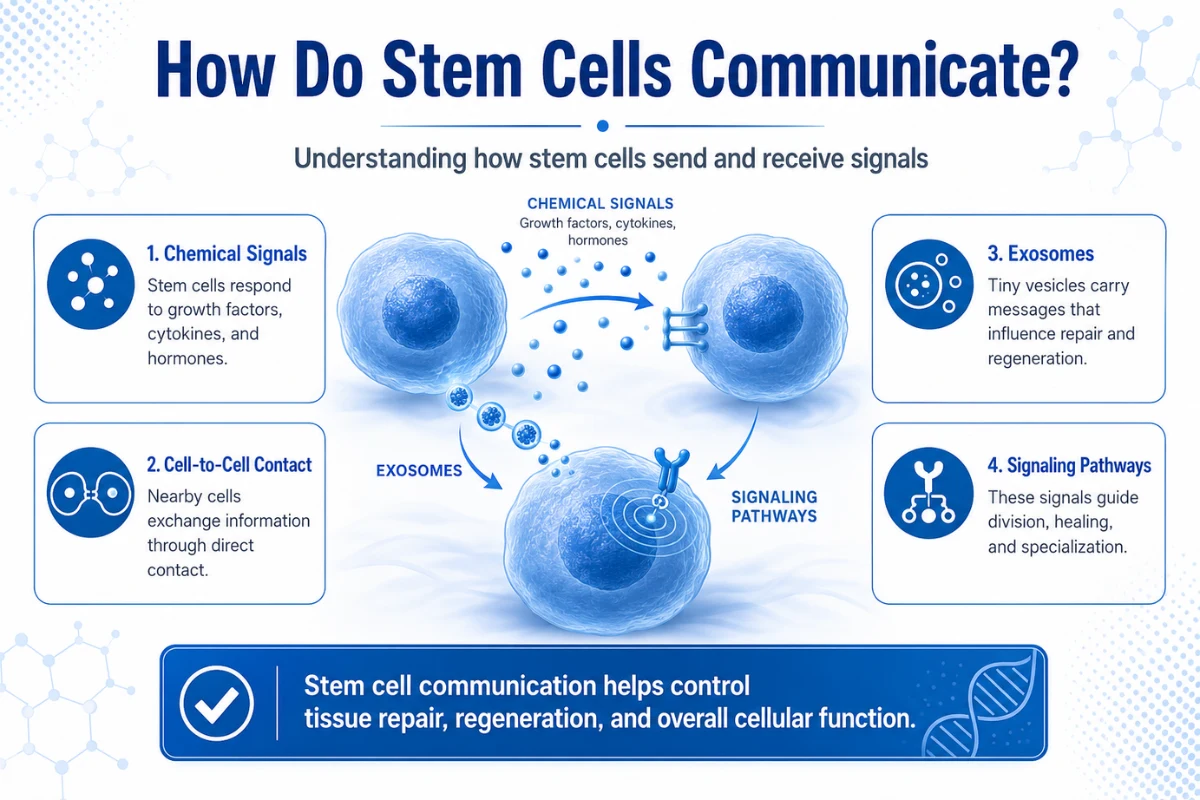
Stem cells communicate by releasing signalling molecules into their surroundings.
These molecules bind to receptors on nearby cells, much like a key fitting into a lock.
Once a signal reaches another cell, it triggers a response.
The receiving cell may then:
- Produce repair proteins
- Reduce inflammation
- Divide into new cells
- Attract immune cells
- Form new blood vessels
- Begin tissue remodelling
- Remain inactive until needed
Each message has a specific purpose.
Some signals encourage healing.
Others help control inflammation.
Some prevent unnecessary scar tissue from developing.
Together, these messages coordinate the body’s natural repair process.
What Are Stem Cell Signaling Pathways?
Stem cell signaling pathways are the biological systems that allow cells to send, receive and interpret these messages.
You can think of them as communication networks inside the body.
Rather than one single pathway, there are numerous signalling systems working together.
Each pathway controls different aspects of cell behaviour.
Some regulate growth.
Others influence inflammation.
Some guide stem cells towards becoming specialised tissue, while others help maintain stem cells in their original state.
Instead of acting independently, these pathways constantly interact with one another, creating a highly organised healing environment.
Why Are Stem Cell Signaling Pathways Important?
Researchers now believe that many of the benefits associated with regenerative medicine come from signalling rather than simple cell replacement.
Stem cells may help create an environment that encourages healing by influencing surrounding tissues.
Healthy signaling pathways may contribute to:
- Tissue repair
- Reduced inflammation
- Blood vessel formation
- Improved cell survival
- Better coordination of healing
- Support for damaged tissues
- Regulation of immune responses
- Balanced scar formation
This explains why regenerative medicine is increasingly focused on the quality of biological communication rather than simply increasing the number of cells.
Cell Signaling Pathways During Injury
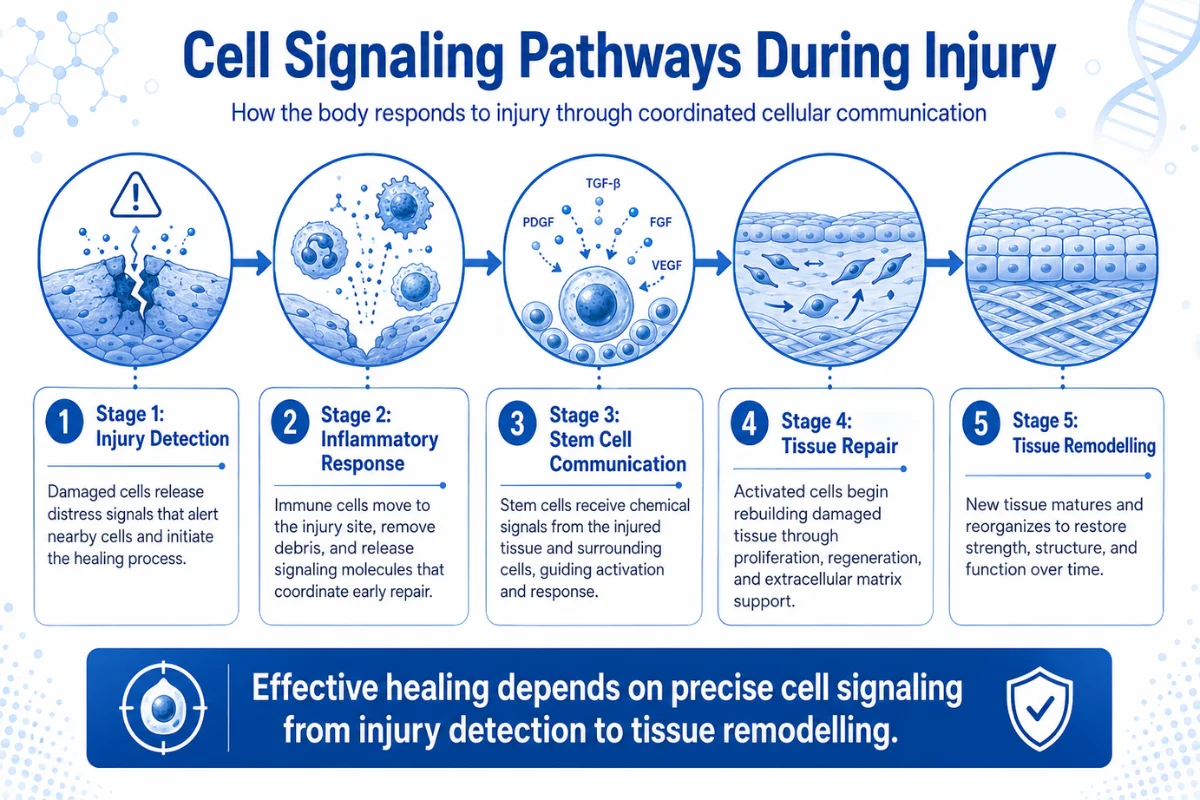
When an injury occurs, the body immediately activates numerous cell signaling pathways.
The injured tissue releases distress signals.
These signals attract immune cells, stem cells and repair cells to the damaged area.
Stem cells respond by releasing additional signalling molecules that help organise the healing process.
The sequence typically includes:
Stage 1: Injury Detection
Damaged tissue sends emergency signals indicating that repair is needed.
Stage 2: Inflammatory Response
Immune cells arrive to remove damaged tissue and prepare the area for healing.
Stage 3: Stem Cell Communication
Stem cells begin releasing signalling molecules that coordinate tissue repair.
Stage 4: Tissue Repair
Repair cells produce new tissue while inflammation gradually settles.
Stage 5: Tissue Remodelling
The repaired tissue continues strengthening over weeks and months.
Healing is therefore much more than simply replacing damaged cells.
It is a carefully coordinated communication process.
How Does Stem Cell Communication Support Healing?
Stem cell communication influences many aspects of recovery.
Helping Control Inflammation
Inflammation is necessary after injury, but excessive inflammation may delay healing.
Stem cell signaling helps regulate this response so that inflammation remains balanced.
Supporting Blood Vessel Growth
Healing tissues need oxygen and nutrients.
Certain signalling molecules encourage the development of new blood vessels, improving circulation within the injured area.
Encouraging Tissue Repair
Stem cells release growth factors that may stimulate nearby cells involved in tissue regeneration.
Rather than directly repairing every tissue themselves, they encourage existing cells to participate more effectively.
Coordinating Different Cell Types
Successful healing requires cooperation between immune cells, blood vessels, connective tissue cells and repair cells.
Stem cell communication helps coordinate these different participants.
Stem Cell Signaling and Regenerative Medicine
Regenerative medicine aims to support the body’s own repair mechanisms.
Instead of simply treating symptoms, regenerative treatments seek to improve the biological environment where healing occurs.
One reason stem cell signaling has attracted so much research attention is that it may explain why regenerative therapies sometimes improve tissue quality without stem cells permanently remaining in the treated area.
Researchers increasingly believe that the signalling molecules released by stem cells may play a larger role than previously understood.
This area of research continues to develop rapidly.
Is Stem Cell Signaling the Same as Stem Cell Therapy?
No.
The two concepts are related but different.
Stem cell therapy refers to treatments involving stem cells.
Stem cell signaling describes how those cells communicate biologically with surrounding tissues.
In recent years, researchers have become increasingly interested in understanding the signalling process itself.
Some regenerative approaches aim not only to introduce cells but also to optimise the healing signals those cells produce.
Why Doesn’t Healing Always Work Perfectly?
If stem cell communication is so effective, why do injuries sometimes heal poorly?
Several factors may influence healing quality, including:
- Age
- Chronic inflammation
- Reduced blood supply
- Diabetes
- Smoking
- Repetitive overload
- Severe tissue damage
- Delayed treatment
- Poor overall health
These factors may affect how efficiently cells communicate during the healing process.
That is one reason why recovery varies from one patient to another.
What Does Current Research Focus On?
Modern regenerative medicine research is increasingly exploring:
- How signalling molecules influence healing
- Which signaling pathways are most important
- How inflammation affects communication
- Why some patients respond differently
- How tissue regeneration can be improved safely
- The role of extracellular vesicles and exosomes
- Personalised regenerative medicine approaches
Although many questions remain, scientists now recognise that successful tissue repair depends on far more than simply having stem cells present.
The quality of communication between cells appears to be equally important.
Can Stem Cell Signaling Replace Surgery?
No.
This is an important misconception.
Stem cell signaling supports biological repair, but it cannot replace every type of treatment.
For example, a completely torn tendon, unstable fracture or severe structural injury may still require surgical repair.
Regenerative medicine should not be viewed as an alternative to every operation.
Instead, it should be considered one part of a broader treatment strategy that depends on the diagnosis, tissue damage and individual patient needs.
A specialist assessment is always necessary before deciding which treatment is appropriate.
Why Is Accurate Diagnosis Still Essential?
Even with advances in regenerative medicine, diagnosis remains the most important step.
Pain alone does not explain what is happening inside a joint, tendon or ligament.
Before considering regenerative options, a specialist needs to understand:
- What tissue is injured
- Whether the damage is acute or chronic
- The severity of the injury
- Whether the tissue can heal naturally
- Whether structural repair is required
- The patient’s activity level and expectations
Only after a complete assessment can an appropriate treatment plan be developed.
The Future of Stem Cell Communication
Stem cell communication is one of the fastest-growing fields in regenerative medicine.
Researchers continue to study how signalling molecules influence tissue repair, inflammation, ageing and recovery after injury.
As our understanding improves, future treatments may become more targeted and personalised.
Rather than focusing only on replacing damaged tissue, medicine is increasingly exploring how to improve the body’s own biological communication systems.
This represents an exciting shift towards understanding not only the cells themselves, but also the messages they exchange.
Final Thoughts
Stem cell signaling is a fundamental part of the body’s natural healing process, allowing cells to communicate through complex cell signaling pathways that coordinate repair, control inflammation and support tissue regeneration. At Dr Marouane’s Orthopedic clinic in Dubai, patients can receive specialist assessment and personalised guidance on regenerative medicine and upper-limb conditions by contacting +971 544 226 123. If you would like to understand whether regenerative treatment may be appropriate for your condition, book a consultation today for an expert evaluation.